EXECUTIVE PERSPECTIVE 1.4 · Customer Success & Scale Strategy
The Strategic Imperative: Why AI Adoption Belongs at the Center of Top-Down Healthcare Planning
AI has outgrown the departmental pilot. For health systems and payers, it now belongs in the enterprise strategic plan.
By Joe Sedlak, MBA, RN, BSN Founder & Principal Advisor, Cornerstone Scale Advisory LLC
November 2026
Over the past three years, artificial intelligence in healthcare has lived largely as a bottom-up, departmental experiment: a revenue cycle pilot in ambulatory here, a generative documentation pilot for a primary care group there, and an exploratory task force charged with “evaluating emerging use cases.”
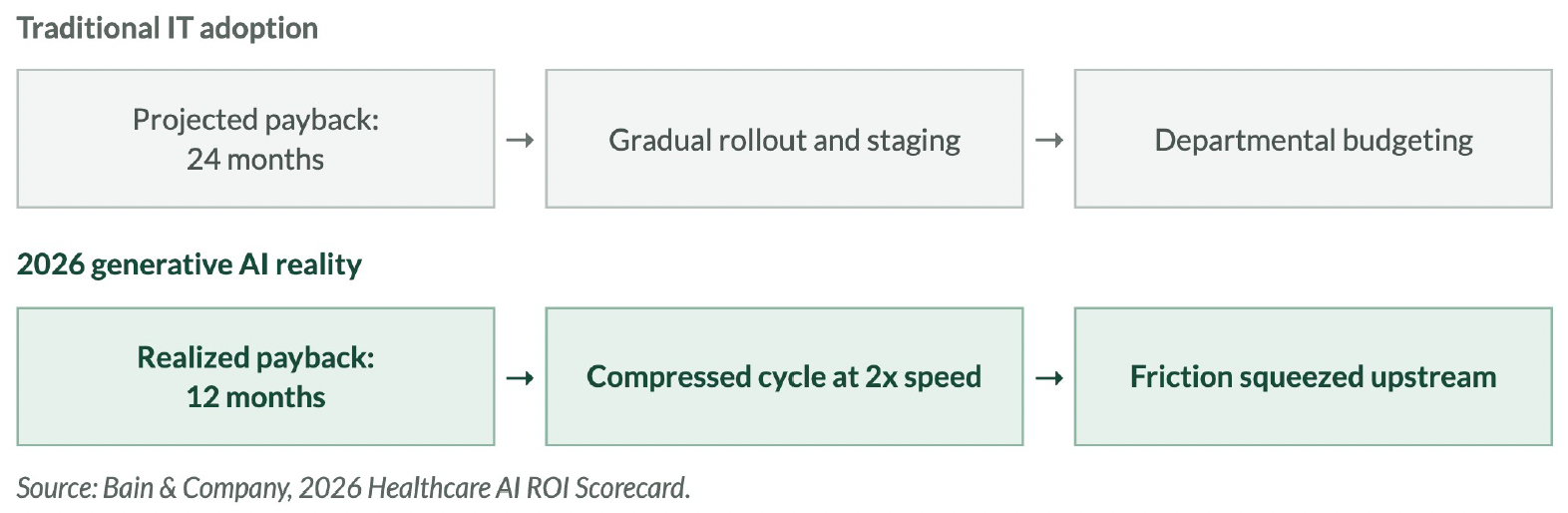
Bain & Company’s 2026 Healthcare AI ROI Scorecard makes one reality undeniable: the exploratory sandbox era is closed. Healthcare organizations are realizing an average 3.5x ROI on generative AI deployments, and they are reaching payback in 12 months instead of the projected 24.
Beneath those headline numbers lies an executive disconnect. Point-solution adoption is accelerating faster than budgeted, yet most healthcare organizations, providers and payers alike, still manage AI as an IT line item or a tactical operational fix rather than an organizing pillar of enterprise strategy.
Treating AI as a departmental efficiency patch blinds executive teams to the structural shifts reshaping healthcare economics: vendor consolidation, clinical adoption friction, and the unaddressed $260 billion administrative waste cycle.
For health system and payer leadership teams entering multi-year capital and operational planning, AI adoption can no longer sit as an appendix to the strategic plan. It must become a foundational, top-down pillar.
Velocity Without Strategy: The 12-Month Payback Trap
Bain’s data highlights a dramatic acceleration: use cases budgeted for two-year paybacks are achieving realized ROI in just 12 months, with 40% of implementations exceeding their initial financial models.
When technology pays back twice as fast as expected, traditional annual budgeting breaks down. In a bottom-up model, individual service lines and operational units procure fragmented solutions to capture quick administrative wins.
The danger is not that these solutions fail to produce ROI. They do. The danger is that they create architectural technical debt and operational silos before executive leadership has established the enterprise roadmap.
When strategic planning accounts for a 12-month value horizon, capital allocation shifts from speculative R&D toward scaled workflow re-engineering. Top-down planning forces leadership to ask:
The Clinical vs. Administrative Divide: Where Capital Actually Works
The scorecard illustrates a stark dichotomy that every health system CEO, CFO, and CMO must confront:
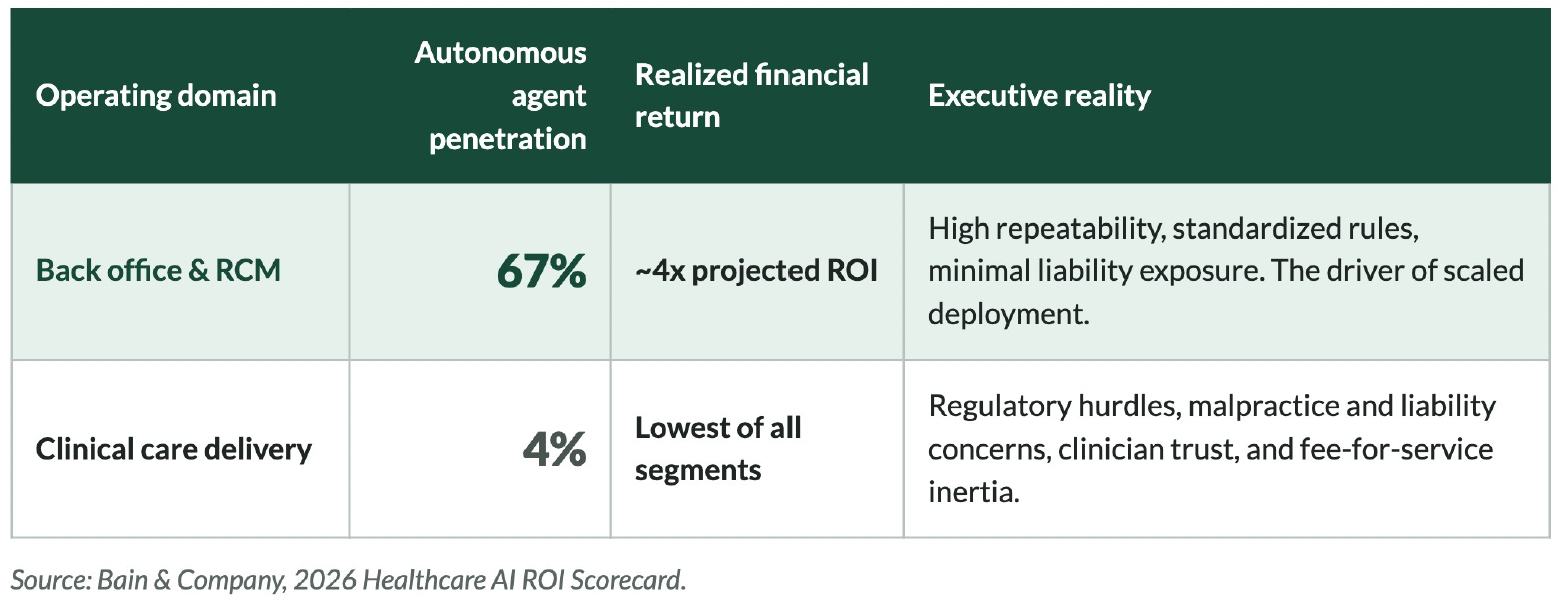
Administrative automation is running at scale. In provider revenue cycle management (RCM), 67% of deployed solutions already operate as semi- or fully autonomous agents, delivering roughly 4x projected returns.
Clinical applications are deeply stalled. Only 4% of provider clinical solutions operate as semi- or fully autonomous agents, and clinical AI delivers among the lowest realized ROI multiples in
the industry.
Where AI is scaling, and where it is stuck:
This divide exposes why bottom-up planning fails. When clinical departments run their own AI pilots without top-down alignment, they run headfirst into clinical liability, physician governance, and EHR workflow friction.
Meanwhile, clinical care delivery represents a $3 trillion expenditure base growing at roughly 5% annually against a shrinking clinical labor force. Point solutions cannot solve this. Unlocking clinical AI requires a coordinated, top-down governance architecture that establishes liability guardrails, rigorous model evaluation frameworks, and explicit clinician-in-the-loop protocols before capital is deployed.
Stack Rationalization: The Best-of-Platform Consolidation
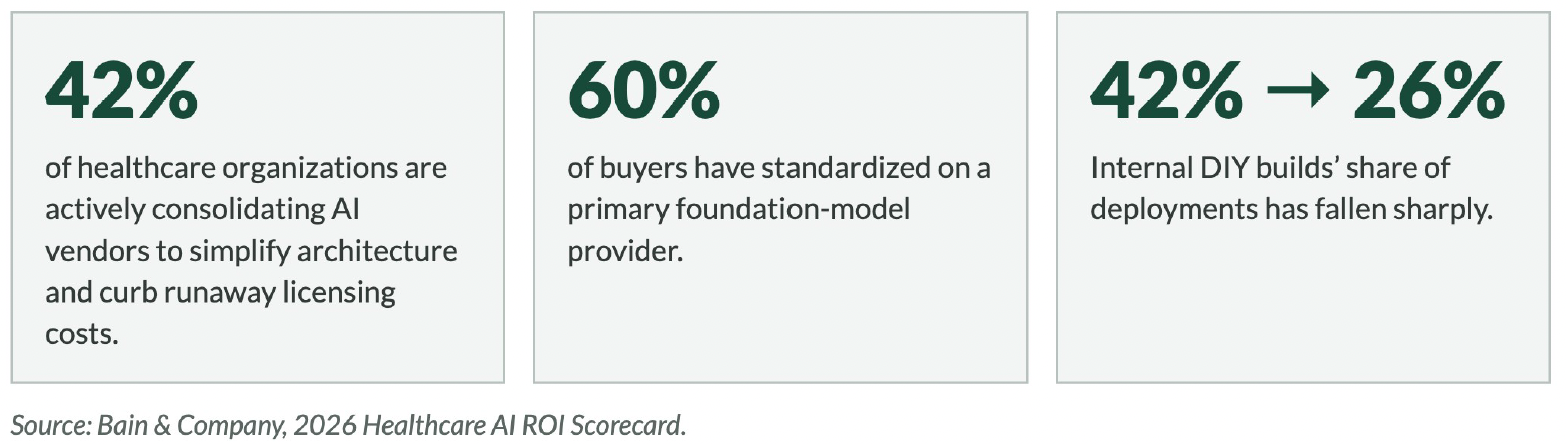
The days of individual departments signing standalone contracts with bespoke AI point solutions are ending. Healthcare buyers are actively dismantling fragmented tech stacks.
The retreat from DIY is telling. Health systems learned that while internal engineering teams can spin up a proof of concept, they cannot reliably maintain, monitor, govern, and audit models at enterprise scale.
When AI adoption is left to department-level buyers, the enterprise ends up with a dozen overlapping point solutions, compounding integration costs and security vulnerabilities.
Top-down strategic planning establishes a deliberate enterprise technology stack. Leadership must select the core platform partners and foundation models that will anchor the health system for the next five years, and require every subsequent clinical and administrative tool to plug into that integrated architecture.
The $260 Billion Prize: Moving Beyond Mirrored Inefficiency
The most critical strategic insight in the Bain scorecard centers on administrative waste. Roughly $1 trillion is spent on healthcare administration in the United States each year, and $260 billion of it is identified as pure waste.
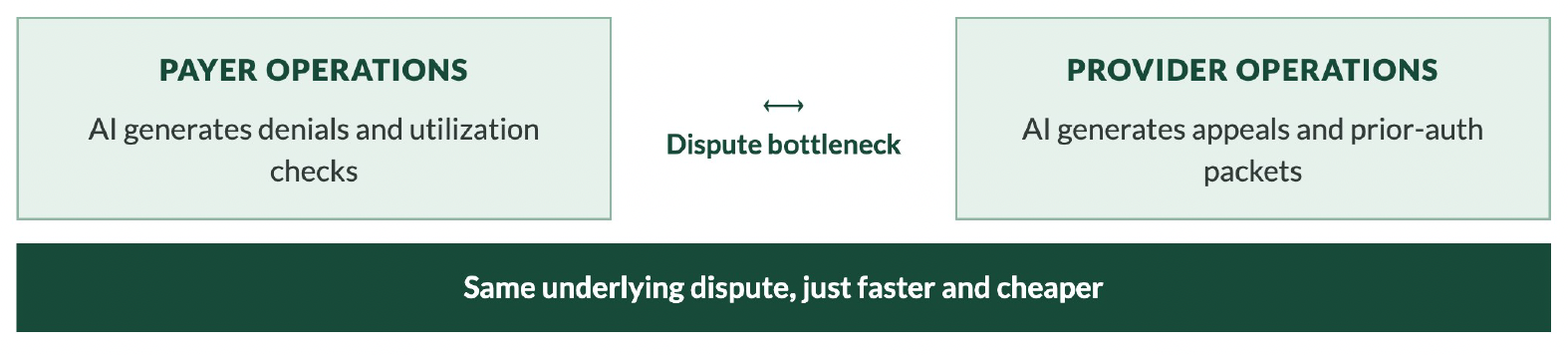
Today, most administrative AI deployment is aimed at fighting bilateral disputes:
Payers deploy AI agents to review medical necessity and automate claims denials. Providers deploy AI agents to predict payer behavior, generate clinical appeals, and clear prior authorization hurdles.
Both sides are spending millions to automate opposite sides of the same administrative collision. AI has made the dispute faster and cheaper, but it has not resolved the structural inefficiency.
This is precisely why AI must sit at the core of executive strategic planning. Solving it requires more than automated billing bots. It requires:
Payer-provider strategic integration: aligning data exchange protocols to support real-time adjudication and transparent, automated rules engines.
Contract modernization: moving toward shared-risk and aligned-incentive models in which neither party benefits from administrative friction.
Real-time settlement: building toward instant transactional clearance that eliminates retrospective claims rework entirely.
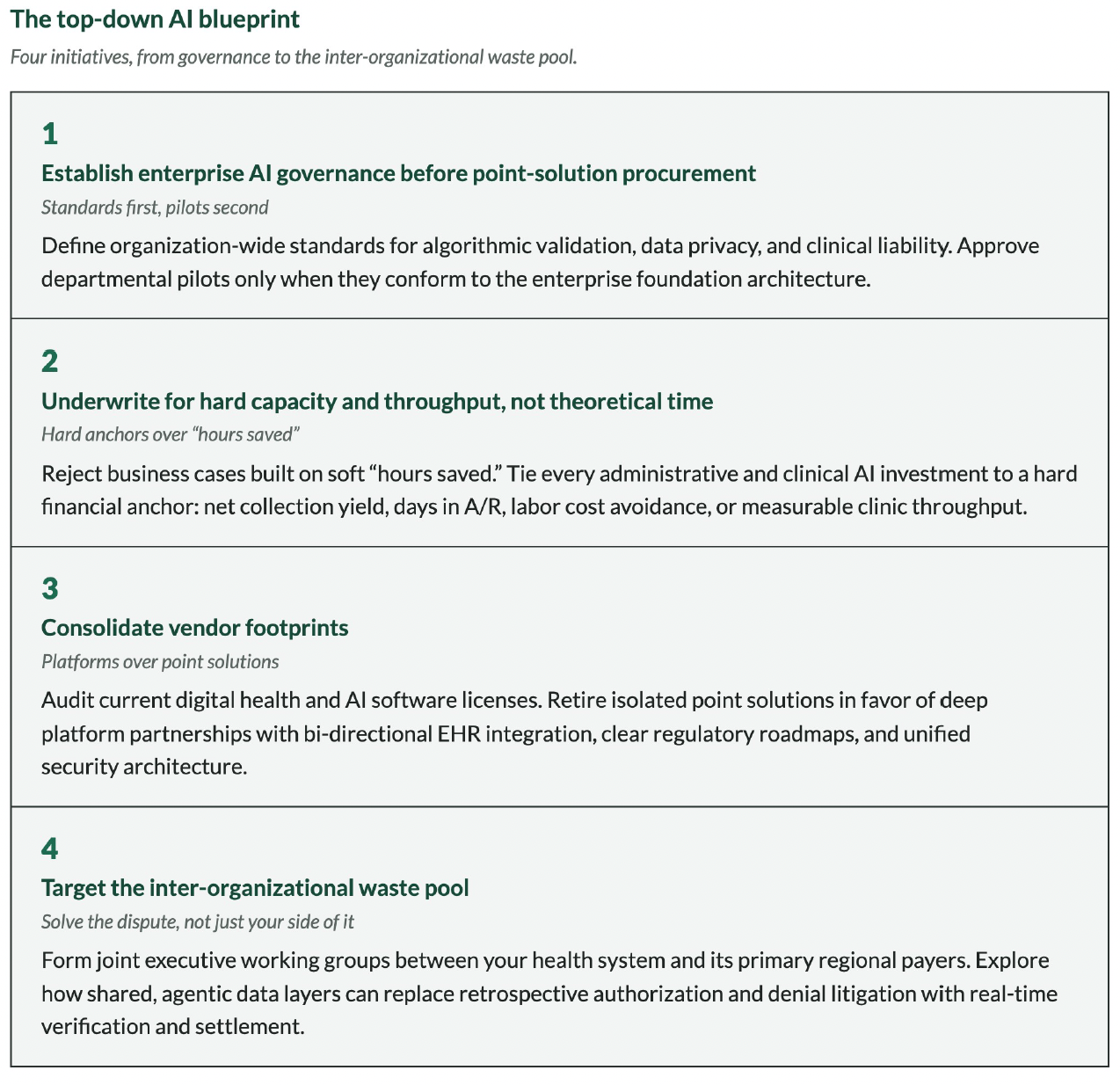
The Strategic AI Blueprint for Healthcare Leadership
To move AI from a patchwork of tactical tools to an engine of structural enterprise value, C-suites and boards must anchor their strategic roadmap around four initiatives.
AI is no longer an emerging technology to be evaluated by an innovation committee.
It is the operating architecture of the modern healthcare enterprise.
Healthcare leaders who position AI at the core of top-down planning will build resilient, scalable organizations. Those who leave it to departmental inertia will spend the next five years managing redundant software stacks and automating broken processes.
Ready to integrate AI strategy into your executive planning roadmap?
Joe Sedlak, MBA, RN, BSN
Founder and Principal Advisor — Cornerstone Scale Advisory LLC
Email: joe@cornerstonegrowthllc.com
If this workflow achieves full automation in 12 months, how do our labor model, capacity planning, and capital deployment change in months 13 through 36?