EXECUTIVE PERSPECTIVE 1.3 · Customer Success & Scale Strategy
Kelly Clarkson, a Mechanical Bird, and the Danger of Winning the Argument:
Why AI-Native CS Must Prioritize De-escalation Over Defense
By Joe Sedlak, MBA, RN, BSN Founder & Principal Advisor, Cornerstone Scale Advisory LLC
October 2026
The line between a minor customer service friction point and a full-blown PR crisis has never been thinner.
When pop star Kelly Clarkson walked into Art of Play, a small curiosity and novelty store in Brooklyn, a brief five-minute interaction over a $15,000 mechanical singing bird named "Molly" quickly escalated into a viral social media standoff. Clarkson publicly criticized the shop on X, likening her experience to Julia Roberts’ infamous treatment in Pretty Woman. The shop responded by releasing security footage, defending its team, engaging in back-and-forth social media exchanges, and cheekily repricing the automaton at $15 million "due to popular demand".
On paper, the business held its ground, presented footage to support its version of events, and gained short-term viral visibility. In reality, the situation spiraled into a wave of online harassment, threats directed at shop staff, and an avoidable reputation firestorm.
While this drama unfolded in a retail shop in New York City, it offers a stark lesson for enterprise B2B SaaS and tech-enabled services leaders: In the modern era of customer success, winning the argument is rarely a win for the business.
As B2B organizations navigate higher acquisition costs, tighter Net Revenue Retention (NRR) benchmarks, and the integration of autonomous agents, the Clarkson feud underscores a critical imperative: Customer Success must transition from reactive damage control to proactive, real-time crisis avoidance driven by AI-native architecture
The Trap of "Winning" the Argument
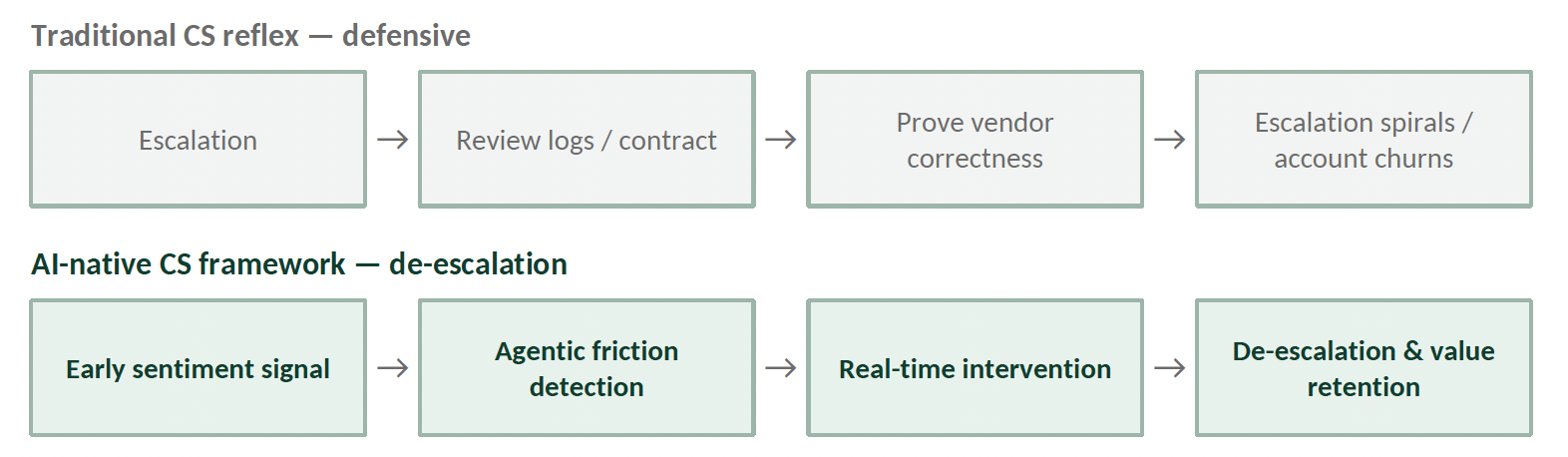
In traditional Customer Success (CS) and support workflows, the default reflex during escalation is defensive:
Who was technically at fault?
Did the employee follow protocol?
Can we prove our side of the story?
In the case of Art of Play, management sought to prove that their employee did nothing wrong, pointing to security footage and context about custom art pieces. But while the business may have won the factual debate, the operational outcome was severe: threats against staff, a harassment campaign, and lasting brand friction.
In B2B enterprise software, this exact dynamic plays out behind closed doors every day. A customer flags an operational gap or perceived missed promise during onboarding. The vendor CS team responds with log files, contractual fine print, or audit trails showing the customer "didn't configure the software correctly"
Winning the technical argument while losing the customer relationship—or burning market goodwill—is a failure of account management. Modern Customer Success isn't about litigating truth; it is about protecting account value and preserving long-term NRR.Enter AI-Native Customer Success: From Reactive to Agentic
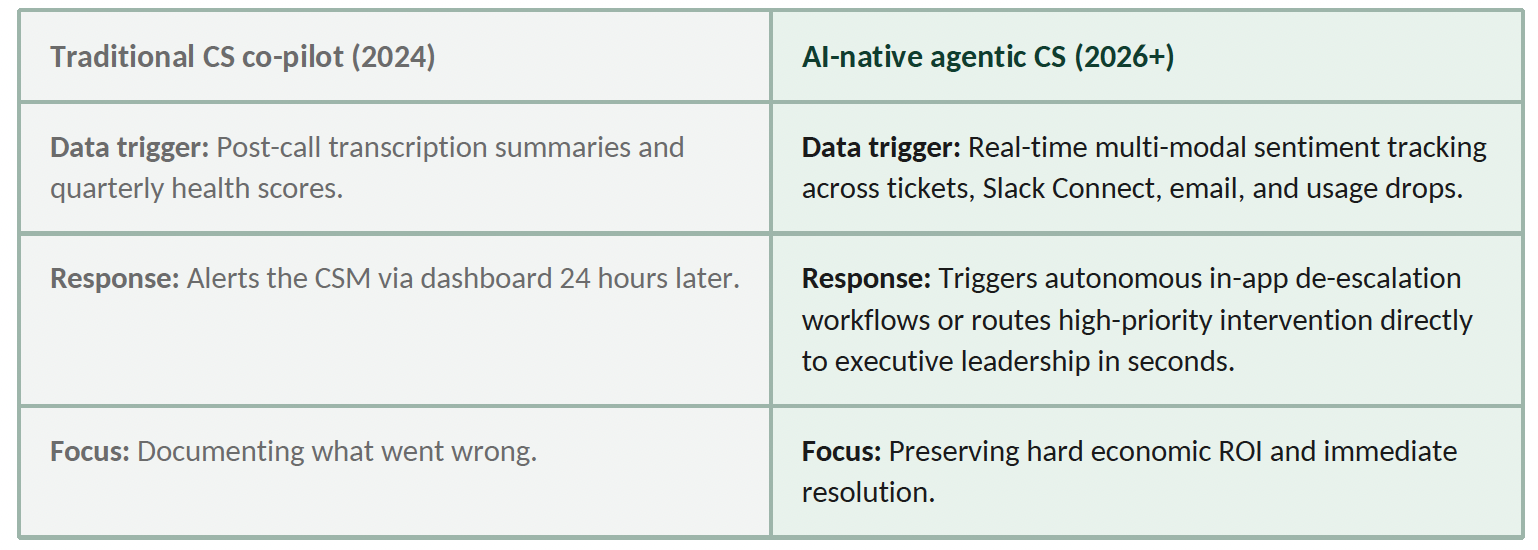
The shift from 2024 co-pilots to 2026 agentic automation is not just about writing emails faster—it is about real-time operational context. Traditional CS tools operate on delayed metrics: monthly health scores, quarterly QBRs, or post-ticket NPS surveys. By the time a metric turns red, the customer has already drafted their exit strategy (or their viral equivalent).
AI-native Customer Success platforms rethink this paradigm by shifting from post-hoc analytics to real-time sentiment and friction interception:
Had an AI-native system been monitoring the interaction points in a business setting, early indicators of frustration—tone changes, repeated queries, rapid session exits—would have triggered a soft-landing protocol long before the friction escalated into an asymmetrical public crisis.
The Four-Step Blueprint for AI-Native Crisis De-escalation
To build an enterprise Customer Success organization capable of surviving and scaling in 2026, founders and executive leaders must operationalize four core principles:
Step 1: Deploy Continuous Sentiment Listening (Multi-channel detection)
Relying on manual CSM updates leaves blind spots. AI-native CS engines process asynchronous channels (Slack Connect, support queues, product analytics) in real time to flag micro-frictions before they become macro-disasters.
Step 2: Enforce the "No-Argument" Policy (Validate first, solve second)
Train both human CSMs and automated support bots to recognize that defensive posturing is an immediate failure mode. The primary goal during any high-friction event is emotional validation and rapid friction removal—not proving vendor compliance.
Step 3: Deploy Agentic Remediation Workflows (Act, don't just draft)
When a high-risk friction event occurs, AI agents should not just draft a polite email. They should autonomously initiate corrective actions: issuing service credits, launching automated diagnostic patches, or scheduling an immediate executive sync with zero manual lag.
Step 4: Anchor CS on Hard Value Metrics (Outcomes over sentiment)
Just as health system buyers discount "soft time saved" pitches, enterprise buyers in crisis mode do not care about defensive explanations. CS teams must anchor every resolution in hard business metrics: restoring pipeline throughput, resolving operational downtime, or guaranteeing SLA outcomes.
Protecting Valuation and NRR in 2026
In today's concentrated market, enterprise growth is driven by retention, expansion, and high Net Revenue Retention. A single high-profile account failure—much like a viral customer feud—can destabilize a brand’s commercial momentum.
The lesson from Brooklyn’s $15,000 mechanical bird isn't that customers are always right. It's this:
The cost of proving a customer wrong is almost always higher than the cost of resolving the issue gracefully.
As AI agents become the front line of customer interactions, enterprise leaders must ensure their technology is designed not just for efficiency, but for empathy, real-time de-escalation, and structural value protection
Ready to align your CS architecture, GTM strategy, and scaling roadmap with the 2026 market?
Joe Sedlak, MBA, RN, BSN
Founder and Principal Advisor — Cornerstone Scale Advisory LLC
Email: joe@cornerstonegrowthllc.com