EXECUTIVE PERSPECTIVE 1.2 · HealthTech & Digital Health Investment
Beyond the AI Wrapper: How Health Tech Leaders Can Win in 2026’s Concentrated VC Market
Why capital is concentrating—and what scaling founders must prove
By Joe Sedlak, MBA, RN, BSN Founder & Principal Advisor, Cornerstone Scale Advisory LLC
October 2026
The digital health venture capital environment in 2026 has sent mixed signals to founders and health system executives alike. On paper, the market is experiencing a massive rebound: year-to-date, health tech and AI-enabled healthcare platforms have raised over $10.8 billion in private funding across VC and PE rounds.
Yet, for scaling founders currently in the market for Series A, B, or Growth capital, that headline figure feels disconnected from daily reality.
While capital is flowing, it is no longer being distributed evenly across early-stage concepts. The funding environment has entered a period of sharp concentration. Mega-rounds ($100M+) represent nearly half of all deployed capital, driven by aggressive bets on category winners that possess deep enterprise integration, proprietary data flywheels, and agentic AI capabilities.
The era of funding “AI wrappers”—lightweight co-pilots or generic ambient listening tools sitting on top of underlying foundation models—is over. Investors are demanding operational rigor, verifiable unit economics, and defensible clinical or administrative moats.
For mid-market and growth-stage health tech platforms, surviving and winning in this concentrated market requires pivoting from surface-level AI narratives to structural enterprise value.
What Venture Capital and PE Are Actually Buying in 2026
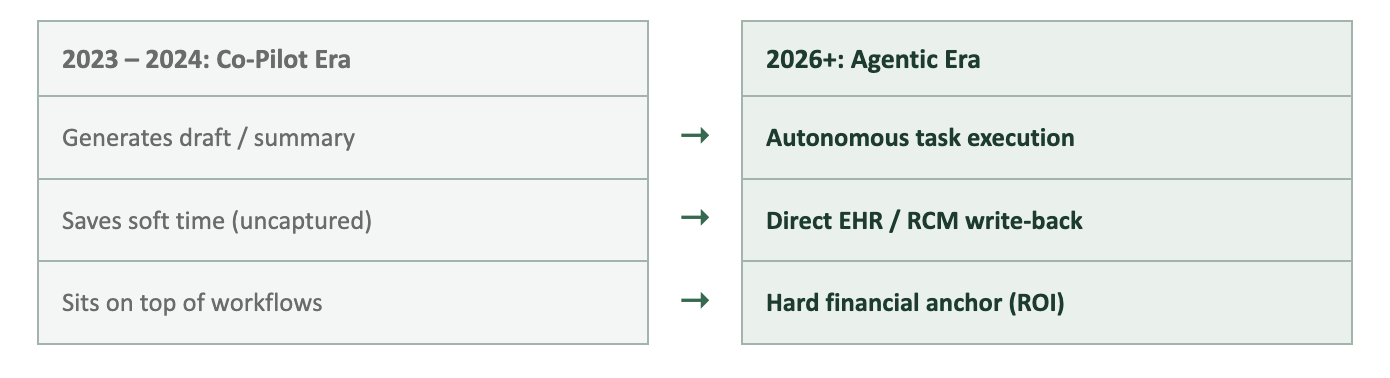
To understand where capital is concentrating, one must look at where health system CFOs and health plan executives are allocating budget. The initial wave of digital health AI focused on co-pilots that assisted human operators—drafting messages, transcribing visits, or generating summaries. While these tools offered clear qualitative efficiency, they frequently struggled to prove hard financial ROI.
In 2026, capital is fleeing simple “drafting tools” and consolidating into Agentic Workflow Automation.
Investors are backing platforms that do not just summarize data, but autonomously execute complex, multi-step administrative processes:
Revenue Cycle Management (RCM) & Billing Automation: Software that directly queries payer systems, resolves authorization bottlenecks, and writes back into the EHR without human intervention.
Patient Intake & Operational Scheduling: Agentic scheduling systems that handle multi-variable provider rules, eligibility checks, and real-time patient outreach.
Interoperability & Data Infrastructure: Deep, bi-directional integration engines that convert unstructured clinical documentation into structured, billable data streams.
The common thread across every major investment in 2026 is system-level stickiness. If a platform can be easily swapped out when an EHR releases a native feature update, it is an un-investable point solution. If it is deeply embedded into operational workflows and owns a proprietary clinical or transactional data loop, it commands a premium valuation.
The Health System CFO Reality: The Single Hard Metric
The primary reason mid-stage health tech companies stall out around $5M to $15M ARR isn’t product quality—it is the gap between soft value propositions and hard economic reality.
When pitching an enterprise health system buyer or a growth equity investor, claiming that an AI tool “saves clinicians 2 hours a day” no longer closes deals. Health system CFOs inherently discount “hours saved” calculations because administrative time saved does not automatically reduce payroll or generate cash.
Winning platforms frame their value around a Single Hard Metric:
Soft value proposition — secondary
Hard financial anchor — primary
“Saves clinicians 2 hours per day on documentation.”
Throughput & Capacity: “Converts 2 saved hours into 1.2 additional billable patient encounters per provider per day ($180 in daily net patient revenue).”
“Reduces administrative burden on billing teams.”
Revenue Integrity: “Reduces initial claim denial rates by 3.2% and lowers cost-to-collect by $0.42 per claim.”
“Improves patient intake satisfaction scores.”
Labor Cost Avoidance: “Decreases reliance on third-party agency staffing and overtime by 18% within 90 days.”
Furthermore, institutional buyers in 2026 routinely apply a 50–60% utilization realism discount to theoretical software value models. A financial projection that models a realistic 3x ROI based on conservative adoption rates carries significantly more executive credibility than an unvetted 10x pitch.
The Executive Playbook: Scaling Beyond the $10M ARR Wall
For scaling health tech leadership teams, navigating this market requires executing on three internal priorities before entering a fundraise:
Step 1: Transition from Point Solution to Platform
If your software solves a single micro-task, enterprise buyers will seek to consolidate it into larger platform suites. Scaling companies must expand their product footprint horizontally or vertically to lock in higher Net Revenue Retention (NRR). Your GTM narrative must pivot from “what our tool does” to “how our architecture permanently lowers your operational cost-to-serve.”
Step 2: Formalize Governance and Risk Oversight Early
In health tech, buyers do not just buy software; they buy clinical validation, data security, and risk mitigation. Moving into enterprise tiering requires robust HIPAA compliance, clinical safety frameworks, and governance protocols that satisfy health system risk committees. Demonstrating these safeguards upfront accelerates sales cycles and removes friction during investor due diligence.
Step 3: Shift from Founder-Led Selling to Repeatable Commercial Motions
Early-stage momentum relies heavily on founder charisma and warm network introductions. However, scaling to a Series B or Growth round requires structured pipeline management, predictable onboarding frameworks, and dedicated customer success architectures that protect NRR.
Building Your Scale Strategy
The $10.8B+ deployed in 2026 proves that capital is readily available for companies that solve real operational bottlenecks and prove their financial value early. However, the bar for scale, governance, and operational discipline has never been higher.
The founders and executive teams that win this era will not just build innovative AI—they will build scalable, enterprise-ready businesses that healthcare operators cannot afford to live without.
Ready to align your GTM strategy, financial models, and growth roadmap with the 2026 market?
Joe Sedlak, MBA, RN, BSN
Founder and Principal Advisor — Cornerstone Scale Advisory LLC
Email: joe@cornerstonegrowthllc.com